Category filter:AllBusiness PlanningCircular EconomyCitiesCreative EconomyDiaryEventsMaritimeOceans economyRecyclingTechnology & InnovationUrbanzero waste
No more posts

February 1, 2024

Introduction

Lumec is involved in a community recycling initiative that is being piloted in Glenwood, Durban. The initiative aims to encourage residents and businesses to separate their waste to increase recycling rates, with a specific focus on integration and support for waste pickers. Waste picker integration has been prioritised at a national level, with formal integration guidelines developed by the Department of Forestry, Fisheries and the Environment in 2020. 

Modern lifestyles, particularly in urban centres, are creating more and more waste. Management of this waste and efforts at reducing waste are becoming increasingly important as we look to the future. Reducing waste to landfill by following ‘zero waste‘ principles not only minimises environmental pollution and greenhouse gas emissions but, if done in partnership with waste pickers, can generate livelihood opportunities and promote inclusivity in the recycling industry. 

As part of efforts to inform the Glenwood community recycling initiative, a survey questionnaire was done with 163 residents and businesses in Glenwood between 1 November and 1 December 2023. Only 3 businesses completed the survey. Of the 160 household participants surveyed, 79% live in free standing houses, followed by 10% in flats/apartments and 6% live in townhouses, duplexes or simplexes.

This article outlines the key findings from the research, including recycling habits, reasons for recycling or not recycling and what is needed to improve recycling practices. 

Waste management and recycling habits

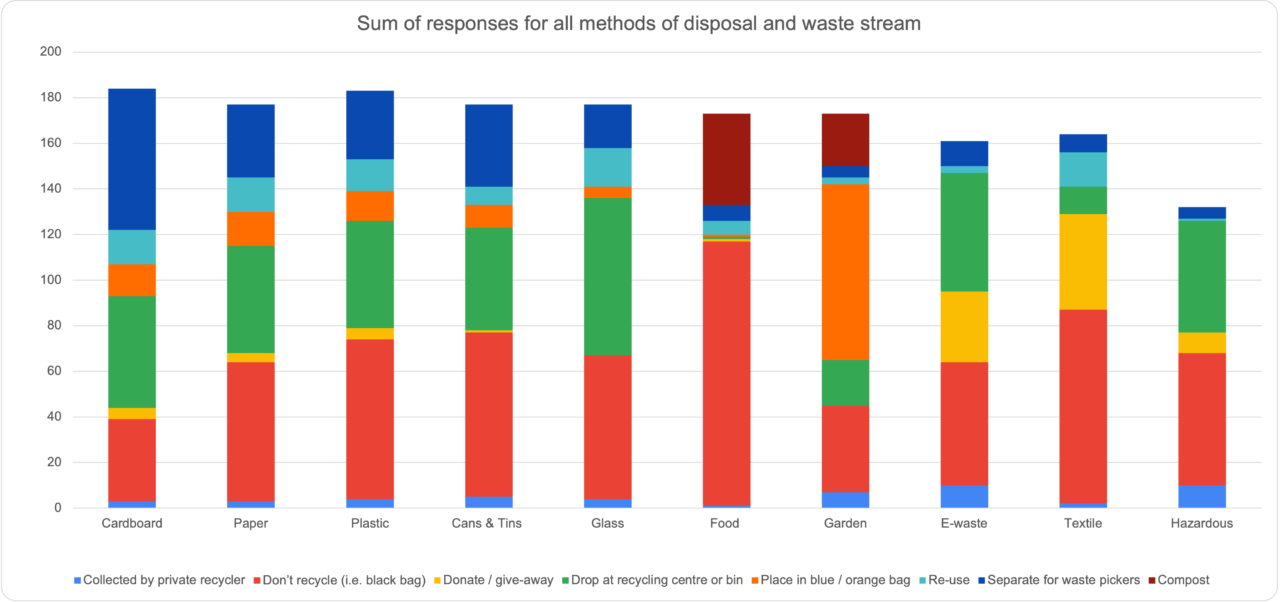
When asked about participants’ waste management practices, placing waste in black refuse bags (i.e., not recycling) is the most common method of disposal (38.4%) across the sample of respondents. The most common form of recycling is dropping recyclable materials at a recycling centre, deposit bin or garden site, followed by separating recyclables for waste pickers. 

Glass is predominantly dropped at a recycling centre/glass bank, as noted by 43% of responses, as well as cardboard, paper and tins and cans, all with approximately 30% of responses.  Cardboard is the material that is most separated for collection by waste pickers, noted by 39% of respondents, followed by cans and tins (22%), paper (20%) and plastic (19%). The most common type of waste not recycled is food waste, at 74% – this is concerning since food waste can be easily diverted to create compost and significantly reduce the burden on DSW’s waste collection efforts and the city’s landfill space. However, besides home composting, there are few other options for diverting food waste at present. In addition when it comes to e-waste (waste from electronics), 38% of respondents noted throwing these in black bags. This is important to address as this waste stream is banned from landfill in SA.
Drivers of recycling

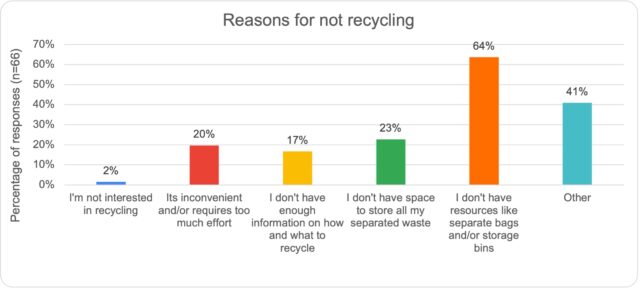
Looking at the reasons people don’t recycle, the most common reason given was “I don’t have resources like separate bags and/or storage bins”, as well as other reasons such as not having the space to separate waste, viewing recycling efforts as inconvenient and too much of an effort to undertake, and lacking the knowledge on how and what to recycle.
The top reasons for recycling include caring about the environment, noting a responsibility to manage the waste that they generate, as well as supporting the waste pickers. 

Significantly, 69% of respondents reported a willingness to start or improve their recycling efforts, while 29% said they were already doing all that they could. 


Support required

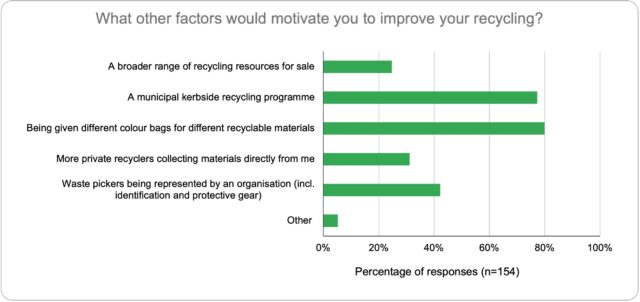
Two frontrunners in ideas that could improve recycling are households and businesses being given different colour bags for different recyclable materials (noted by 80% of respondents) and a municipal kerbside recycling programme (chosen by 77%). Other ideas include waste pickers being represented by an organisation and having protective equipment and identification as well as more private recyclers collecting materials directly. 
In identifying what type of information would support people in improving recycling, 66% said information about where and how to recycle would be useful, 52% said information about how to support waste pickers would assist, and 44% said they’d like information about what materials can and can’t be recycled. In addition, respondents also would like tips about how to identify and separate recyclable materials and to know what impact their recycling activities are having. The Glenwood community pilot will focus on providing such information.

Conclusion

The Glenwood population sampled are relatively conscious about managing their waste – over 60% of respondents practise some form of recycling across the waste streams they generate, and as noted, almost 70% want to start or improve their waste management practices. While there is likely sampling bias here (i.e. those who agreed to complete the survey are more likely interested/involved in recycling efforts), the results are nonetheless significant. 

In light of the results of the survey, the Glenwood community recycling initiative can have a significant impact in addressing some key areas highlighted in the results of the research. To improve recycling in the area, we believe there are a two critical aspects that need to be addressed:

  • Households need to be encouraged and supported to take the lead in their own waste management practices. More information should be provided to them on the importance of reducing waste and recycling the waste that is generated, including more information about how to apply zero waste principles; how, what and where to recycle in Durban; and simple methods and tips for separating and storing waste.
  • More efforts need to be made to integrate waste pickers into formal recycling efforts. Ideally, waste pickers need to be represented by an organisation such as the South African Waste Pickers Association (SAWPA) and registered onto the South African Waste Picker Registration System (SAWPRS). This will allow them to be more formally represented, recognised and protected (i.e. ID cards, uniforms and protective gear), assist them to better coordinate their efforts and take part in waste picker integration projects, and to receive additional remuneration for the recyclables they collect via the Extended Producer Responsibility (EPR) scheme.

Way Forward

Through this initiative, we intend to work closely with waste pickers, NGOs, the municipality, and other community groups to make sure that waste pickers are integrated into the recycling value chain. We also aim to consolidate and share information about how to reduce and reuse (as a first priority), and then, what, how and where to recycle.

We look forward to supporting efforts to improve recycling through collaboration, driving research processes and sharing insights, to make a difference in our city! If you are interested and would like to engage with us, contact us here


tuna-sushi-1280x868.jpg

August 28, 2019

In Part One of this tuna inspired blog, we framed the problem of canned tuna:

  • Not a single can of tuna on Spar’s shelves contained tuna sourced in South Africa, and 
  • Most of this tuna is SASSI red listed

We also discussed the current methods of catching tuna, namely, hand or pole fishing, netting, fish farming and artificial fish farming. In Part Two we consider whether entering this market is plausible in South Africa.

Tuna is one of the most profitable types of aquaculture. This is especially true of bluefin tuna, which supplies the sushi industry. Therefore, Tuna is one of the most popular and globally traded seafood products. Globally, tuna quotas have been met, in fact, the relevant bodies are currently considering how to lower quotas. This means that supply is likely going to remain flat, while demand continues to increase, especially for bluefin tuna. Which means that there is going to be a significant gap in the market opening up where tuna prices are likely to increase and demand for artificially bred tuna will rise. 

If South Africa were to step into this gap, we would need to invest heavily in aquaculture technologies currently being utilised in Japan and the USA. Already, South Africa is home to several freshwater and saltwater fish farms, including aquaponics plants, and is home to some of the leading fisheries scientists in the world. Furthermore, the funding of aquaculture has been prioritised with relevant Development Funding Institutions (DFIs). The first local Aquaculture Finance and Investment Seminar was successfully held in March 2019. 

It seems, therefore, that the capacity and funding stores may exist in South Africa but given the niche status of artificial tuna farming, this may not be the most effective use of this capacity, despite the potential returns. We have the additional challenge in South Africa of rough sea waters – harbours would need to be utilised or built for successful farming. Furthermore, the quick win would be in farming tuna for the sushi market where margins are high, not the canned tuna market. Upon writing, the most expensive shredded canned tuna on Spar’s shelf was R18.49 and the cheapest was R15.99. This is the band within which farmed tuna would need to stay if it were to be purchased by the mainstream consumer. 

There is evidence that sustainable products are being purchased at a higher growth rate than unsustainable products, especially amongst millennials, but this evidence is from high-income countries. The willingness of low to middle-income consumers to pay a premium for sustainably sourced products is yet to be proven. Interestingly, in South Africa, Woolworths shoppers are paying a premium for sustainable, locally sourced shredded canned tuna – upon writing, this premium was R5.50.

So, to answer the questions we started with,

  • Why are we unable to compete with Thailand on this product? It seems that we may not want to from a sustainability perspective. Furthermore, quotas are being reduced, which means that there likely isn’t much opportunity for new market entrants.
  • Would the market be willing to purchase locally sourced canned tuna at a mark-up? Possibly. They already do from Woolworths. However, this would likely be the smaller, higher income bracket. 
  • Is this an industry that has the opportunity to grow our local economy, without any negative impact on our ocean ecology? The percentage of pole and hand fishing licenses that are currently being utilised in South Africa would need to be determined – if they are being underutilised, then there is scope for growth, however, this is capped. There is little scope for growth for large scale commercial fishing and farming due to quotas and high barriers to entry. There is room for growth in the implementation of artificial tuna fish farming, however, this would likely require significant investment and the willingness of major global players to share their intellectual property. Furthermore, this fish farming technique does create waste, so the impact on ocean ecology would still need to be considered.

We would welcome any experts or data that could confirm or refute our conclusions, which are based on high-level, secondary research only. 

At the end of the day, if locally sourced, sustainable canned tuna isn’t feasible, we could always consider growing tuna in a lab or tuna that isn’t tuna at all

Additional reading on the status of South African aquaculture here.


IMG_20190725_191532-1280x960.jpg

August 8, 2019

As economists, we are acutely aware of the economic benefits that arise from local manufacturing, which is one of the reasons Lumec employees share a passion for supporting locally produced goods and services. Earlier this year we noticed something surprising - not a single can of tuna on Spar's shelves contained tuna sourced in South Africa. Every brand of tuna stated that its tuna was sourced from Thailand. 


June 13, 2016

The need for a resilience project in Durban has been further illuminated by the fires of protesters in recent weeks. It is with great credit to the eThekwini Metro that they have acknowledged the importance of this project and have not only commenced with research and a strategy but have created a ‘sustainability and resilience’ function within the metro.

Last week Resource attended a public stakeholder workshop where an update on the resilience programme was presented by Chief Resilience Officer, Debra Roberts. The 100 Resilient Cities Programme (100RC) was pioneered by the Rockefeller Foundation in order to ‘help cities around the world become more resilient to the physical, social and economic challenges that are a growing part of the 21st Century’ (100 RC website). eThekwini is one of those 100 cities and has been conducting research towards a resilience strategy since 2014. This started with a preliminary resilience assessment, which resulted in six (rather broad) ‘focus areas‘. Dahlberg Consultants were then contracted to conduct further interviews, focus groups and desktop research to provide an objective view. They isolated the barriers to achieving the goals defined under the six focus areas and the root causes of these barriers. Through this, they were able to establish six ‘levers of change‘.

The resilience team felt that the levers of change were still too vague and not implementable and thus conducted further stakeholder engagement, which resulted in two ‘Resilience Building Options‘ for Durban. These are:

  • RBO 1: Integrated informal settlements planning: This includes upgrading information settlements with regard to education, environment, municipal services, social cohesion and economic opportunities and leveraging opportunities presented by the informal sector as a whole.
  • RBO2: Addressing environmental challenges in the governance of Ingonyama Trust land. Ingonyama Trust land is rich in biodiversity and is developing rapidly but there is little co-ordination between traditional leadership systems and eThekwini planning officials. This creates an opportunity to enhance communication and leverage both natural and human resources in these areas.

It is pleasing that the priorities that surfaced have brought the invisible and geographically secluded areas to the forefront of eThekwini’s resilience planning. These areas are largely unknown and excluded from planning, communication and policy but are filled with opportunity. The team are going to spend the rest of the year consulting and conducting research in order to develop a strategy and implementation plan around these two RBOs. It is recommended that all stakeholders who have an interest in the growth of eThekwini become involved in the process and throw their support behind it. This is one of the most important and forward-thinking projects to come out of the metro and the public has a responsibility to assist and to hold the city accountable to reaching these goals in an inclusive manner.

To get in touch with the team and find out more about the project see www.durban.gov.za/100RC