Category filter:AllBusiness PlanningCircular EconomyCitiesCreative EconomyDiaryEventsMaritimeOceans economyRecyclingTechnology & InnovationUrbanzero waste
No more posts
Copy-of-Beige-White-Minimalist-Pattern-Page-Border-Document-A4-Landscape-3-1280x905.jpg

October 30, 2024

What is Zero Waste?

We live our lives within a badly designed materials system, depicted by a linear economic model. In this model, scarce resources are extracted, manufactured, packaged, sold, used (often briefly) and then discarded. 

One of the main myths sustaining this model is the simple idea that there is such a thing as “away”.  Deceptive words like, “waste” would have you believe that our materials are designed with a natural ending encoded into them, but they are not.  The materials we toss aside so conveniently, are durable. They are so durable that they pose one of the largest and most costly problems our governments, civil societies and natural ecosystems must face today. We’re producing more waste than available disposal methods can handle, leading to the rapid depletion of landfill space, increased pollution, and strained waste management systems. The unfortunate truth is that recycling is not the answer to this problem. Recycling is itself an expensive and incomplete endeavour.

Being the industrious and persistent species human beings are, another solution has been developed. “Zero waste” is an ambitious goal defined best by the Zero Waste International Alliance:

“The conservation of all resources by means of responsible production, consumption, reuse, and recovery of products, packaging, and materials without burning and with no discharges to land, water, or air that threaten the environment or human health.”

The concept of Zero Waste was designed to help us see the materials we come across for the resources they are. A rich and active value chain has been experienced by every one of the simple consumable items that pass through your hands. 

The Zero Waste hierarchy is a helpful graphic that can teach us to prioritise our approaches to dealing with our earth’s resources. According to our experts, recycling is only the fourth port of call.
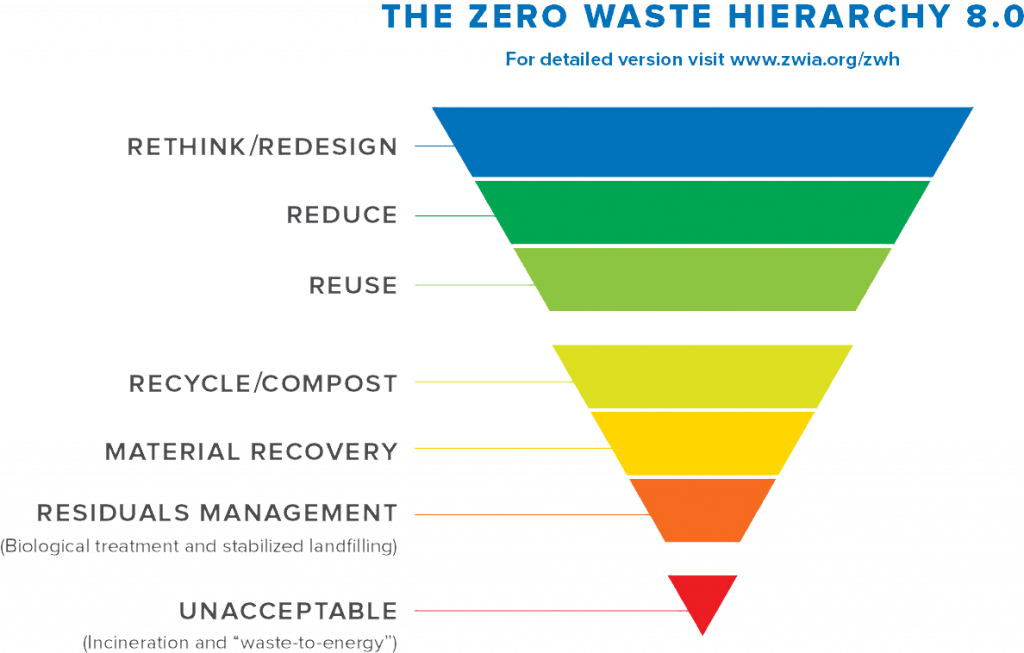
 

Zero waste hierarchy as per the International Zero Waste Alliance


Rethink/Redesign: The first thing we need to do is shift toward a closed-loop model. Instead of just dealing with the aftermath of our linear way of using materials, we need to dig deeper and tackle the root causes of the problem. By creatively revamping our systems, we can solve the problem of waste far more effectively and sustainably. 

Reduce is about taking action to cut down on the amount and toxicity of resources, products, packaging, and materials we use, along with minimising their negative impacts on the environment and our health. While the focus is on reduction, it’s important to remember that everyone has basic needs that should be met—so not everyone will need to reduce in the same way.

Reuse: This is all about reusing products or their components for the same or similar purposes they were originally designed for. It’s about finding ways to keep using items in a way that maintains their value, usefulness, and functionality. 

Recycle/Compost: This involves taking discarded items and either mechanically transforming them into new products or materials, or biologically breaking them down to enrich the soil. It’s a way to give waste a new lease on life and support a healthier ecosystem.

Material Recovery: This refers to efforts aimed at recovering extra materials after previous processes, excluding practices like energy recovery or transforming materials into fuels (these methods aren’t considered acceptable because they don’t align with the goal of true material recovery).

Residuals Management: This involves responsibly managing waste materials to ensure they don’t harm the environment or public health. It’s about examining what was discarded and understanding the reasons behind the waste.

Unacceptable: These are systems and policies that promote wastefulness and pose risks to both the environment and public health. Such practices include waste incineration and other similar waste-to-energy processes that create pollution.

This hierarchy can (and has) informed policy makers, private industry, and communities in steering our human societies away from a linear model of consumption towards a circular one. A circular economy is a model designed to minimise waste and make the most of resources by keeping products, materials, and resources in use for as long as possible. It emphasises regeneration, restoration, and recycling to create a sustainable system that benefits businesses, society, and the environment. The Ellen MacArthur Foundation wrote the book on this concept, providing resources and frameworks to help transition toward circular practices. 

Zero Waste is a useful concept that sits within the broader circular economy model, and can guide us towards achieving circular solutions. However, how can it inform you?

The Zero Waste lifestyle for households

Bea Johnson is a pioneer of zero waste living. She has achieved what seemed impossible: to reduce the waste of her household of four down to one jar a year. 

How did she achieve such a feat? Luckily, she has created her own zero waste hierarchy to help us do the same. Similar to the hierarchy designed by the Zero Waste International Alliance, recycling is only the fourth resort. 
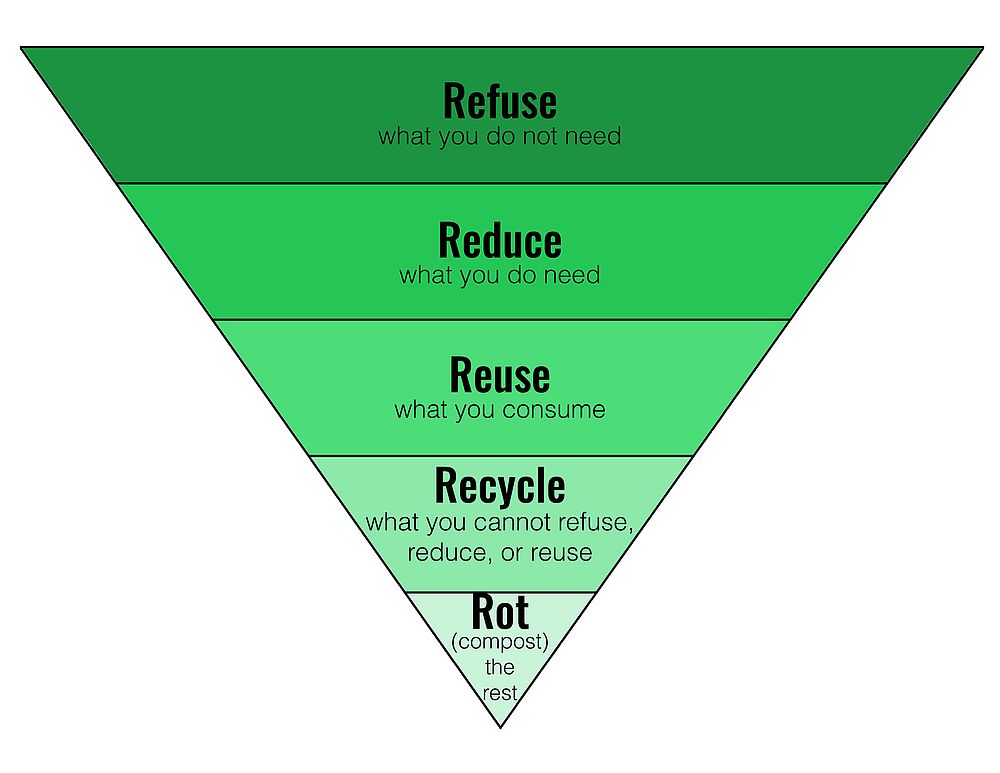
Zero waste hierarchy according to Bea Johnson


We have taken her hierarchy and localised it for you.

Refuse. The first thing Bea advises is to be uncompromisingly selective in what you are bringing into your house. She describes each purchase as a vote you are throwing. When you support a certain product, you are endorsing the value chain that led that product to you. It goes even further, even the simple act of accepting a product from someone else (like that terribly exciting corporate freebie) is an endorsement. You are saying to the suppliers: there is value in this, make more! 

What solutions do you have access to?

  • Faithful to Nature is founded on principles of ethical shopping. Their range of products is so comprehensive this may just be a one stop solution for you!
  • Conscious Lifestyle Collective partners with small business owners who are committed to both people and the planet. These businesses aim to make a positive impact by offering sustainable products and services.

Reduce. Changing your shopping habits towards conscious awareness of the products you place in your trolley (and the plastics they are wrapped in) is the quintessential step to reducing your waste. Another useful step is to plan out your meals to avoid excessive organic waste. 

What solutions do you have access to?

  • Read this article: How to Quit Plastic to start your journey to zero-plastic!
  • Meal planning apps are an excellent way to get on top of that shopping hassle and simultaneously reduce the amount of waste in both your shopping habits and shopping purchases.  Watch this video to hear a review of some of the best meal planning apps available. The apps compared are: 
    • Yummly 
    • Meallime
    • Prepear 
    • RecetteTek 
    • SideChef
    • DietWiz
    • Paprika 

Reuse. Replace all your disposable items (again a very deceiving word) with reusable items. Arm yourself with the basics: water bottles, clothes, glass jars, containers. It is through these items that you will be able to free yourself from the burden of packaging. Bea describes the cheeky interaction of going to stores with bags and tupperwares. 

What solutions do you have access to?

  • Thrift stores are an amazing way to contribute to the longevity of products and to explore your style and tastes in an affordable manner. Keep your eyes peeled for our up-coming thrift store database. 
  • The possibilities of reuse are endless. Get creative in repurposing your household items. Get some fresh ideas online. 

Recycle. Wherever you cannot refuse, reduce or reuse, it is time to recycle! 

What solutions do you have access to?

  • Support waste-pickers by separating cardboard, PET plastic and aluminium cans into a separate bag. Waste-pickers are the unsung heroes of recycling in South Africa, and deserve both respect and support in the difficult circumstances of the work they do. 
  • For other recyclables visit this database to find a recycler near you.

Rot. Organics in landfills contribute to large amounts of methane gas, which contributes to the terrifying GHG cliff-edge we are racing towards. Start to compost your organic waste. 

What solutions do you have access to?

  • There are hundreds of unique ways to compost your organics. We recommend you consider the Bokashi Composting method. This is a convenient way to store and break-down all kitchen waste, including meat, which can then be buried or added to a compost heap! Check out Bokashi Bran and Earth Probiotic – the two main suppliers of Bokashi starter kits in South Africa. 

The directive of adopting a zero-waste lifestyle may seem cumbersome at first glance, but that is only because it is up against decades of consumption-based marketing. The truth is, once you begin to adjust your lifestyle into a more sustainably conscious model, you are revisiting the customs human societies were built on. You will begin to free yourself and your family, and engage in fun new projects together.  A really inspiring example of how this practice can prompt a philosophical shift is Kamikatse, a town in Japan that produces no waste at all! Watch this video and feel good about our world! 

If you think this way of life is something you would like to try, visit this guide to set you on your path towards zero waste. 

WZW.jpeg

June 12, 2024

Why composting?

In South Africa, 10 million tonnes of food go to waste every year – this is a third of the 31 million tonnes that are produced in the country annually. South Africa’s food waste contributes to the alarming global figure of more than US$1 trillion worth of food being thrown away every year. About 90% of waste in South Africa – including food waste and other organic waste – is disposed of in landfills. The organic waste in landfill results in the production of carbon-dioxide and methane gas – greenhouse gases. Methane gas is one of the largest contributors to climate change and global warming – over a 20-year period, it is 80 times more potent at warming than carbon dioxide. In addition, landfills in general cause surface and groundwater contamination, air and soil pollution, and negative impacts on local communities such as noise, foul odours and dust. Not only are these rising emissions extremely worrying, but the generation of these gases at landfills is unnecessary. There are opportunities to divert this waste from landfill through waste beneficiation processes such as composting. Composting can reduce methane emissions by 99% as methane-producing microbes are not active when there is enough oxygen present. 

Challenges in moving towards a circular economy

In South Africa, the large bulk of organic waste is still sent to landfill. With the climate crisis becoming increasingly dire it is important to shift from a linear economy model – where waste ends up in landfills as its final end – towards promoting more sustainable, circular economy models. There are challenges to making this shift. South Africa has relatively low costs for landfilling which is a driver of its popularity as the most common waste management method. As landfills are the predominant method of disposing of waste, and this is the status quo for all municipalities, it is challenging to change this, or for the private sector to get involved. In many cases, diverting waste from landfill is perceived to have high costs – often requiring high capital costs to set up and higher operating costs.  In addition, there is the perception that there are minimal benefits from alternative waste management and it is thus a challenge to create a shift in mindset towards transitioning to a more circular economy model. 

The Warwick Zero Waste pilot project

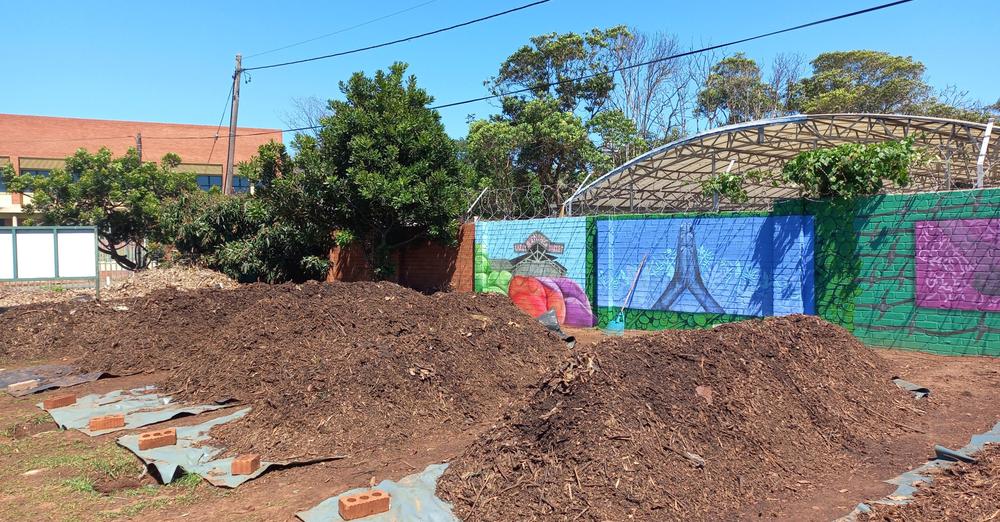
Creating attractive, feasible, and successful alternative models is the first step towards creating a shift in the status quo in South Africa. With this in mind, the Warwick Zero Waste (WZW) project was started in early 2021 with the aim to create an easy to replicate, zero waste to landfill case study for large informal markets commonly found in Africa, starting with the Early Morning Market (EMM) in Warwick Junction, Durban. The WZW project is being implemented by groundWork, the Durban University of Technology’s (DUT) Urban Futures Centre (UFC), and Asiye eTafuleni. Research undertaken at the EMM shows that, on average, each year, almost 400 tonnes of waste was being sent to landfill, with 84% of this being organic waste (i.e., fruit and vegetables). The goal of this project was to find a way to divert waste from the EMM in a small-scale, decentralised, and closed loop system, by setting up a composting site in a nearby site. Using the 2km radius from the EMM, Durban Botanic Gardens (only 1.5kms away) was identified as the best option to pilot this composting site. This reduces the travel distance of the waste by over 66 kms. In addition, the site already has brown and green garden waste from Botanic Gardens which could be combined to make high quality compost. After securing support from the Botanic Gardens team, the pilot process was started in June 2022, whereby 1 wheelie bin of food waste per week was combined with the garden waste from the Botanic Gardens, to create 16 compost heaps over a period of 4 months. Since then the WZW team has initiated a scale-up process, where a 1-ton bakkie was used to create a single large compost windrow. During March 2023, the WZW initiated a further scaling up, utilising two deliveries a week of food waste from a 4-ton truck to create 12 windrows, along with relevant drainage to capture leachate run-off. Given the success of the initial pilot project in creating a good quality compost product, the WZW team identified that significant potential exists to scale-up even further and divert a more substantial amount of food waste from the EMM into the production of compost.

Watch “People at the Heat of Change”, a beautiful short documentary about the Warwick Zero Waste project.

Cost-Benefit Analysis as a tool

In order to gain broader buy-in, the implementing team needed to garner the support of key stakeholders in the Municipality. An important way of doing this is to show the financial and other benefits of this alternative model. Lumec conducted a cost-benefit analysis to evaluate if diverting food and garden waste from landfill into compost production results in a net benefit or cost to the eThekwini Municipality. In addition to economic factors, this approach also considers the social and environmental costs and benefits of implementing this project. 

The analysis of the WZW project drew on data from research over a period of 3 years (2021-2023) and considered costs including: removing food waste from the Early Morning Market; removing plant waste from the Botanic Gardens; landfilling costs, including landfill airspace costs; external costs of landfill activities, and costs of greenhouse gas emissions from waste at landfill. Against these costs, three scenarios for an alternative composting project were modelled:

  1. Scenario 1: no building, with the composing occurring in the open with channels to capture leachate runoff;
  2. Scenario 2: a painted steel structure with a concrete base and roof structure; and
  3. Scenario 3: a galvanised steel structure with a concrete base and roof structure.

Various costs such as staff (4 people for every 400 tons of waste), machinery and equipment including a truck, wood chipper and chainsaw, and the various construction costs were then projected over a period of 10 years for all 3 scenarios. Significantly, findings show that over a 10-year period, all scenarios result in savings for the Municipality. While it is significant that there are positive financial outcomes, in addition to the savings for the Municipality, there are numerous other benefits, including: 

  • Reduced environmental and climate impact due to a reduction in methane gas emissions
  • New green employment opportunities in the city
  • The opportunity for reinvestment of savings into EMM infrastructure towards improved working conditions for the traders
  • Opportunities for training or awareness raising with students and the general public
  • A model for strong transversal partnerships within the municipality
  • Creation of a strong, circular economy model for replication across the city and country

Collaboration is key

What has been key to the initial and ongoing success of this project is commitment and buy-in by all relevant municipal units and departments. In eThekwini, the Business Support, Tourism, Markets, and Agri-Business unit, Parks, Recreation and Culture unit and Cleansing and Solid Waste unit signed an MOU which was approved by council, which stipulates that they are all committed to the scaling up of this pilot.

In 2024, the WZW team will be starting a pilot at another fresh produce market in Durban, the Bangladesh Market in Chatsworth. If successful, this could lead to a City-wide scaling of such projects at other fresh produce markets and parks. In addition, the proliferation of these small-scale, close loop decentralised composting sites are likely to be applicable to many other municipalities around the country. Decentralised models such as these would be key to diverting large amounts of organic waste from landfill, enabling circular practices which contribute to a more sustainable future.

Conclusion

The cost-benefit analysis (full report can be found here) resulted in a net benefit to the City when considering the savings from current waste disposal practices and the benefits of producing compost. This indicates that similar small-scale, decentralised composting initiatives would also produce a net benefit to the City. A new analysis will undertaken at the Bangladesh Market to test this hypothesis, and the results will be compared with those of the EMM pilot in order share insights and learnings from these two pilots.

This project and its scale-up is funded by the UMI Fund, with additional funding in 2024 from the Global Methane Hub.


February 1, 2024

Introduction

Lumec is involved in a community recycling initiative that is being piloted in Glenwood, Durban. The initiative aims to encourage residents and businesses to separate their waste to increase recycling rates, with a specific focus on integration and support for waste pickers. Waste picker integration has been prioritised at a national level, with formal integration guidelines developed by the Department of Forestry, Fisheries and the Environment in 2020. 

Modern lifestyles, particularly in urban centres, are creating more and more waste. Management of this waste and efforts at reducing waste are becoming increasingly important as we look to the future. Reducing waste to landfill by following ‘zero waste‘ principles not only minimises environmental pollution and greenhouse gas emissions but, if done in partnership with waste pickers, can generate livelihood opportunities and promote inclusivity in the recycling industry. 

As part of efforts to inform the Glenwood community recycling initiative, a survey questionnaire was done with 163 residents and businesses in Glenwood between 1 November and 1 December 2023. Only 3 businesses completed the survey. Of the 160 household participants surveyed, 79% live in free standing houses, followed by 10% in flats/apartments and 6% live in townhouses, duplexes or simplexes.

This article outlines the key findings from the research, including recycling habits, reasons for recycling or not recycling and what is needed to improve recycling practices. 

Waste management and recycling habits

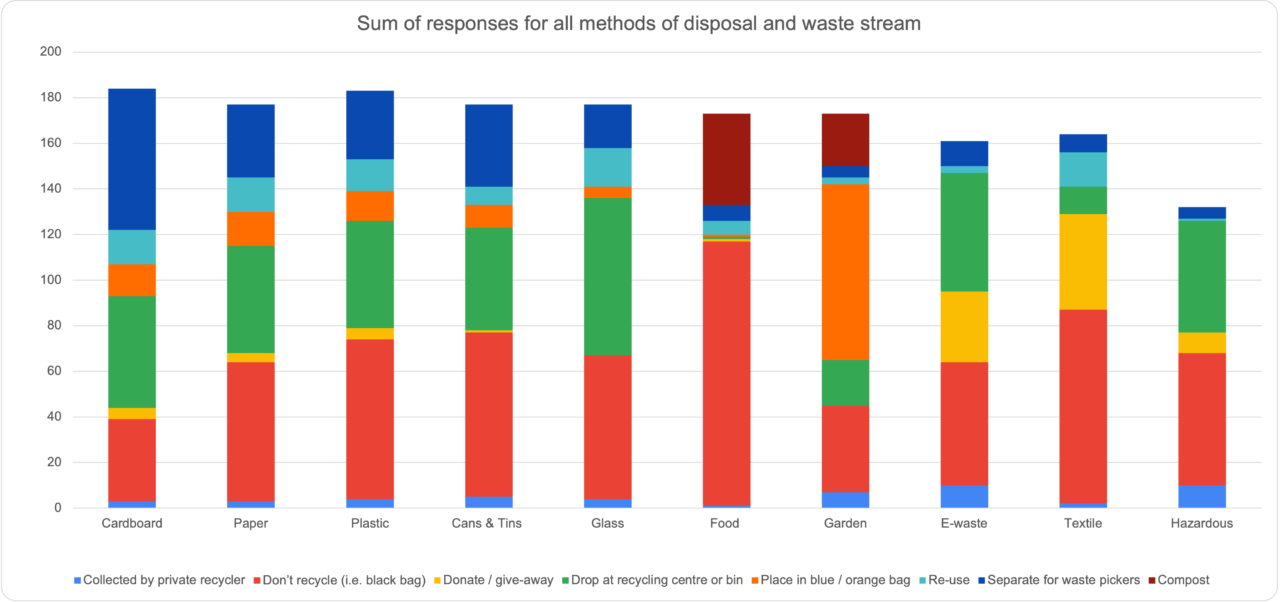
When asked about participants’ waste management practices, placing waste in black refuse bags (i.e., not recycling) is the most common method of disposal (38.4%) across the sample of respondents. The most common form of recycling is dropping recyclable materials at a recycling centre, deposit bin or garden site, followed by separating recyclables for waste pickers. 

Glass is predominantly dropped at a recycling centre/glass bank, as noted by 43% of responses, as well as cardboard, paper and tins and cans, all with approximately 30% of responses.  Cardboard is the material that is most separated for collection by waste pickers, noted by 39% of respondents, followed by cans and tins (22%), paper (20%) and plastic (19%). The most common type of waste not recycled is food waste, at 74% – this is concerning since food waste can be easily diverted to create compost and significantly reduce the burden on DSW’s waste collection efforts and the city’s landfill space. However, besides home composting, there are few other options for diverting food waste at present. In addition when it comes to e-waste (waste from electronics), 38% of respondents noted throwing these in black bags. This is important to address as this waste stream is banned from landfill in SA.

Drivers of recycling

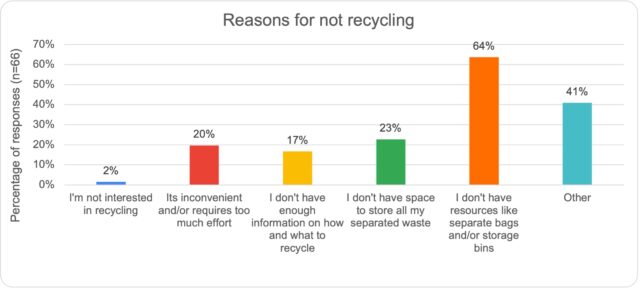
Looking at the reasons people don’t recycle, the most common reason given was “I don’t have resources like separate bags and/or storage bins”, as well as other reasons such as not having the space to separate waste, viewing recycling efforts as inconvenient and too much of an effort to undertake, and lacking the knowledge on how and what to recycle.

The top reasons for recycling include caring about the environment, noting a responsibility to manage the waste that they generate, as well as supporting the waste pickers. 

Significantly, 69% of respondents reported a willingness to start or improve their recycling efforts, while 29% said they were already doing all that they could. 


Support required

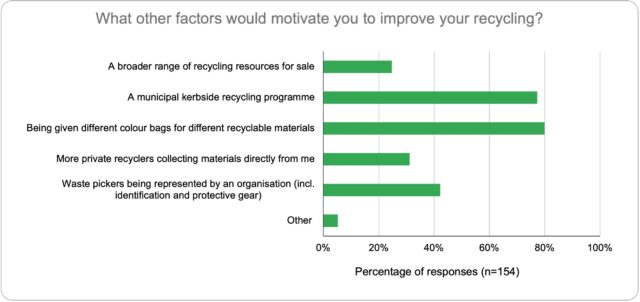
Two frontrunners in ideas that could improve recycling are households and businesses being given different colour bags for different recyclable materials (noted by 80% of respondents) and a municipal kerbside recycling programme (chosen by 77%). Other ideas include waste pickers being represented by an organisation and having protective equipment and identification as well as more private recyclers collecting materials directly. 

In identifying what type of information would support people in improving recycling, 66% said information about where and how to recycle would be useful, 52% said information about how to support waste pickers would assist, and 44% said they’d like information about what materials can and can’t be recycled. In addition, respondents also would like tips about how to identify and separate recyclable materials and to know what impact their recycling activities are having. The Glenwood community pilot will focus on providing such information.

Conclusion

The Glenwood population sampled are relatively conscious about managing their waste – over 60% of respondents practise some form of recycling across the waste streams they generate, and as noted, almost 70% want to start or improve their waste management practices. While there is likely sampling bias here (i.e. those who agreed to complete the survey are more likely interested/involved in recycling efforts), the results are nonetheless significant. 

In light of the results of the survey, the Glenwood community recycling initiative can have a significant impact in addressing some key areas highlighted in the results of the research. To improve recycling in the area, we believe there are a two critical aspects that need to be addressed:

  • Households need to be encouraged and supported to take the lead in their own waste management practices. More information should be provided to them on the importance of reducing waste and recycling the waste that is generated, including more information about how to apply zero waste principles; how, what and where to recycle in Durban; and simple methods and tips for separating and storing waste.
  • More efforts need to be made to integrate waste pickers into formal recycling efforts. Ideally, waste pickers need to be represented by an organisation such as the South African Waste Pickers Association (SAWPA) and registered onto the South African Waste Picker Registration System (SAWPRS). This will allow them to be more formally represented, recognised and protected (i.e. ID cards, uniforms and protective gear), assist them to better coordinate their efforts and take part in waste picker integration projects, and to receive additional remuneration for the recyclables they collect via the Extended Producer Responsibility (EPR) scheme.

Way Forward

Through this initiative, we intend to work closely with waste pickers, NGOs, the municipality, and other community groups to make sure that waste pickers are integrated into the recycling value chain. We also aim to consolidate and share information about how to reduce and reuse (as a first priority), and then, what, how and where to recycle.

We look forward to supporting efforts to improve recycling through collaboration, driving research processes and sharing insights, to make a difference in our city! If you are interested and would like to engage with us, contact us here


June 26, 2023

Introduction

Lumec intern, Semkelisiwe Ndlela, recently attended a number of virtual sessions at the World Circular Economy Forum 2023. The forum was held in Helsinki between the 30th May – 2 June 2023. She found the Forum, which was hosted and attended by circular forward thinkers and pioneers, an inspirational and educational experience. You can access the online recordings here.  

The sessions covered a range of issues ranging from ways of regenerating nature to reverse supply chains for the electronics sector, specifically looking at minerals in Africa. Acceleration sessions further discussed the transition for the built environment and circularity in cities. 

This blog provides Semke’s key takeaways from the sessions, and ideas around how South African cities can lead in the transition towards creating more circular economies.

Key Takeaways

The sessions highlighted various points that are important towards achieving a circular economy:

  1. Collaboration among stakeholders was a key sentiment that was repeatedly raised. All sectors must work together and drive collaboration to ensure a greater impact within the transition towards a circular economy. 
  2. Integrating the youth and harnessing their skills, innovative ideas and technologies can play a role in accelerating this transition. Their ideas and their innovative nature bring a much-needed, fresh perspective. 
  3. The importance of strong regulations to shift momentum towards the transition, and the role government and private sector can play in levelling the playing field while supported by these regulations. 
  4. Sharing information, capturing data and documenting metrics can help shape insights and influence future decisions. 
  5. Banks and the private sector are also crucial in providing support for small businesses and start-up projects through financial support and driving partnerships. The transition can be accelerated through supporting small projects and ideas to scale up and have more impact in this global fight. 
  6. Projects that address the root cause of current problems are important to drive progress – it is important to shift mindsets by raising awareness about the extent of environmental degradation currently occurring, and painting a picture of our bleak future if we do not make the much-needed transition.
  7. There should be a focus on innovative business models that view products and materials as a service (especially in the minerals sector) for efficient usage, and this needs planning from the onset.

Learnings for South African Cities

The sessions sparked conversations and insights into what we can enforce towards developing South African cities in line with sustainability and circularity, whilst also shifting away from linear economic practices across sectors. Cities are key towards this transition. Below are some of the points we must consider in driving the transition towards a circular economy in our cities:

  1. Capturing data, developing metrics and monitoring these are essential in creating a baseline to establish solutions for a circular economy and measure impact.
  2. Circular economy strategies, which are key to developing a clear transition path and are often developed at a national or provincial level, need to be regionalised and implemented at a city-level.
  3. Cities must invest in circular infrastructure to close material loops. Therefore, municipalities, government and the private sector must play a role in supporting capital-intensive infrastructure that drives circularity.
  4. Cities must ensure strong partnerships and collaborations with organisations and individuals that are leading the circular economy transition to leverage knowledge and advice.
  5. Cities must support establishment of productive recycling value chains and encourage design that eliminates waste. They should also promote reverse supply chains through public participation.
  6. Cities must make an effort for local food systems to be more regenerative through supporting community composting initiatives and sustainable agricultural practices.
  7. There needs to be a shift in mindset away from overproduction and unnecessary consumption, which requires solutions that address the root cause of such behaviour and influence systematic change.

Cities therefore should really focus on piloting small projects that all contribute to meeting circular economy strategy goals and United Nations Sustainable Development Goals (SDGs).

We are eager to support the transition to a more circular economy through collaborating, supporting research processes and sharing insights. If you are interested and would like to engage with us around the transition towards a circular economy, please click here to contact us.


KMBC-Main-e1664791052468.jpeg

October 3, 2022

Introduction

Lumec recently conducted a market and viability assessment for Green Corridors’ KwaMashu Beneficiation Centre (KMBC). The purpose of the study was to determine the market potential of 5 green products that have been prototyped at the KMBC and to assess the viability of each based on current alternatives in the market. 

Green Corridors is doing some amazing work at their KMBC, prototyping a range of products made from materials that are not easily or commonly recycled. Using materials such as Spanish Reed (an alien invasive plant) and spent grain from a local brewery (my personal favourite – That Brewing Co), they are making bokashi compost; they are also using non-recyclable plastic, crushed glass, street-swept sand and building waste to make green pavers.

Green Corridors have recently launched a Backabuddy campaign to raise funds to install 200 pavers at a school in KwaMashu, so please do support this great initiative! 

Goal 

The ultimate goal of the study was to determine if an SMME could viably produce any/all of the 5 products. This was done by comparing the market price of current alternatives to the cost at which these products can be manufactured and sold. To determine the latter, we developed a viability model that calculates the cost to produce each product using current KMBC processes as a baseline. Since they are testing a range of processes and using almost 30 materials as inputs into the 5 products, it was a really interesting process that required a unique approach. 

Viability Model

As a starting point, the value chain of each material was mapped to understand the unique process related to this, from source through to being in a state that can be input into the production process (i.e pre-processed). The model then calculated a cost per unit (either kilogram or litre) of each material based on sourcing costs, transport costs, and pre-processing costs. Pre-processing includes manual sorting processes (labour only) as well as machine-driven processes such as shredding, granulating, chipping, and crushing (labour and electricity). 

The cost of the specific processes that each material undergoes was calculated (e.g. R1 per kilogram to manually sort and then R0,5 to crush a single material). By adding the cost of each pre-processed material that goes into each product, this yielded a material input cost per product. For example, it costs R1.5 for one material and R2 for the second material, which results in a total material input cost of R3.5 for the product.

Thereafter, the cost of manufacturing each product was calculated by determining the cost of operating each machine required to produce the product (again, both labour and electricity costs), and adding this to the total material input cost to result in a total production cost. An average cost was calculated for overheads, as well as interest repayments and depreciation on equipment and machinery depending on each product, which resulted in an average cost per unit (e.g. R5 per product is overheads, R2.5 is interest repayment and R1.5 is depreciation).

Adding these all together, and then adding a profit margin, the retail cost of each product was calculated. This was then compared with the retail price of current market alternatives to answer the question of whether or not an SMME could viably produce these products. A few products were considered viable, while a few were not – this is mainly given that alternative products on the market, using virgin materials only, are significantly cheaper. In addition, products such as polystyrene are expensive to transport and process given their light weight, and push up the cost of each product. 

Conclusion

This process assisted Green Corridors (a) to understand the cost of producing recyclable materials as inputs into their various products, (b), to adjust the specific mix of recyclable materials to optimise viability, and (c) to determine which products have the greatest market potential. 

Learnings

From the process, the following learnings can be shared with other SMMEs in the recycling industry:

  1. It is very important to have a good understanding of the entire value chain of your business and the factors that influence the cost at each point of the value chain. This includes the cost of sourcing and transporting your materials and the cost of operating your machinery (especially labour and electricity costs). 
  2. Most recycling business models fall short due to the cost of transport, so sourcing materials as locally as possible is the key. Companies such as Ocean Plastic Technologies are looking at localised pre-processing solutions where plastic can be shredded on site to increase the viability of transporting plastic. 
  3. Developing a strong model based on a detailed value chain analysis will allow you to test the viability of different business models and approaches, which will support development of a rigorous financial model. Knowing the processes within a certain value chain where costs are too high, or which materials are pushing the price of your product out of the market, are essential in building a stronger business model.
  4. Doing some economic market research, even at a high level, will assist to build a robust business case for your business or product/s and boost your financial model. In our experience, most funders want to see a financial model that is supported by economic market research. Ultimately, if you can show that there is potential in your target market to sell X units per year and you can produce each product at Y rands, you can be fairly confident that your revenue projections are accurate and funders will be more likely to buy into your business model. 

If you are interested in finding out more, click here to contact us.