
Why composting?
In South Africa, 10 million tonnes of food go to waste every year – this is a third of the 31 million tonnes that are produced in the country annually. South Africa’s food waste contributes to the alarming global figure of more than US$1 trillion worth of food being thrown away every year. About 90% of waste in South Africa – including food waste and other organic waste – is disposed of in landfills. The organic waste in landfill results in the production of carbon-dioxide and methane gas – greenhouse gases. Methane gas is one of the largest contributors to climate change and global warming – over a 20-year period, it is 80 times more potent at warming than carbon dioxide. In addition, landfills in general cause surface and groundwater contamination, air and soil pollution, and negative impacts on local communities such as noise, foul odours and dust. Not only are these rising emissions extremely worrying, but the generation of these gases at landfills is unnecessary. There are opportunities to divert this waste from landfill through waste beneficiation processes such as composting. Composting can reduce methane emissions by 99% as methane-producing microbes are not active when there is enough oxygen present.
Challenges in moving towards a circular economy
In South Africa, the large bulk of organic waste is still sent to landfill. With the climate crisis becoming increasingly dire it is important to shift from a linear economy model – where waste ends up in landfills as its final end – towards promoting more sustainable, circular economy models. There are challenges to making this shift. South Africa has relatively low costs for landfilling which is a driver of its popularity as the most common waste management method. As landfills are the predominant method of disposing of waste, and this is the status quo for all municipalities, it is challenging to change this, or for the private sector to get involved. In many cases, diverting waste from landfill is perceived to have high costs – often requiring high capital costs to set up and higher operating costs. In addition, there is the perception that there are minimal benefits from alternative waste management and it is thus a challenge to create a shift in mindset towards transitioning to a more circular economy model.
The Warwick Zero Waste pilot project
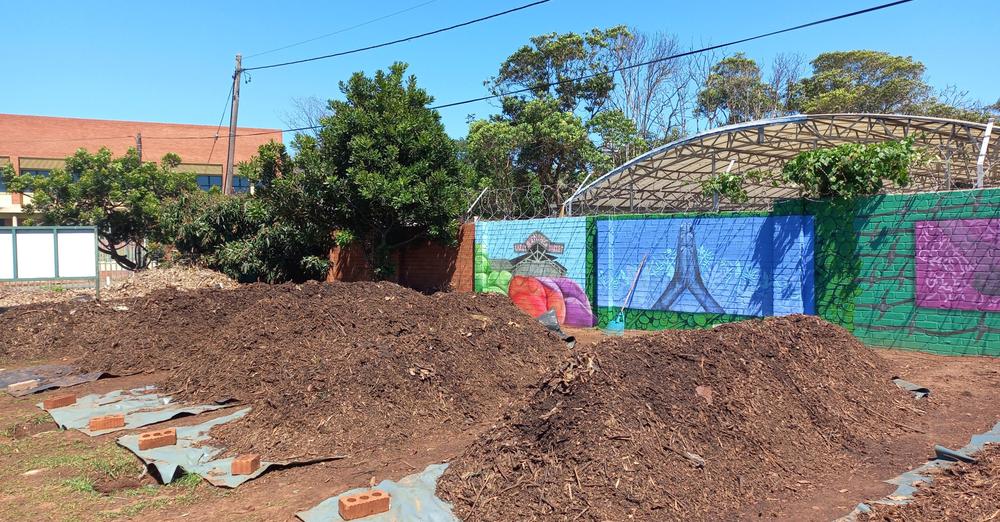
Creating attractive, feasible, and successful alternative models is the first step towards creating a shift in the status quo in South Africa. With this in mind, the Warwick Zero Waste (WZW) project was started in early 2021 with the aim to create an easy to replicate, zero waste to landfill case study for large informal markets commonly found in Africa, starting with the Early Morning Market (EMM) in Warwick Junction, Durban. The WZW project is being implemented by groundWork, the Durban University of Technology’s (DUT) Urban Futures Centre (UFC), and Asiye eTafuleni. Research undertaken at the EMM shows that, on average, each year, almost 400 tonnes of waste was being sent to landfill, with 84% of this being organic waste (i.e., fruit and vegetables). The goal of this project was to find a way to divert waste from the EMM in a small-scale, decentralised, and closed loop system, by setting up a composting site in a nearby site. Using the 2km radius from the EMM, Durban Botanic Gardens (only 1.5kms away) was identified as the best option to pilot this composting site. This reduces the travel distance of the waste by over 66 kms. In addition, the site already has brown and green garden waste from Botanic Gardens which could be combined to make high quality compost. After securing support from the Botanic Gardens team, the pilot process was started in June 2022, whereby 1 wheelie bin of food waste per week was combined with the garden waste from the Botanic Gardens, to create 16 compost heaps over a period of 4 months. Since then the WZW team has initiated a scale-up process, where a 1-ton bakkie was used to create a single large compost windrow. During March 2023, the WZW initiated a further scaling up, utilising two deliveries a week of food waste from a 4-ton truck to create 12 windrows, along with relevant drainage to capture leachate run-off. Given the success of the initial pilot project in creating a good quality compost product, the WZW team identified that significant potential exists to scale-up even further and divert a more substantial amount of food waste from the EMM into the production of compost.
Watch “People at the Heat of Change”, a beautiful short documentary about the Warwick Zero Waste project.
Cost-Benefit Analysis as a tool
In order to gain broader buy-in, the implementing team needed to garner the support of key stakeholders in the Municipality. An important way of doing this is to show the financial and other benefits of this alternative model. Lumec conducted a cost-benefit analysis to evaluate if diverting food and garden waste from landfill into compost production results in a net benefit or cost to the eThekwini Municipality. In addition to economic factors, this approach also considers the social and environmental costs and benefits of implementing this project.
The analysis of the WZW project drew on data from research over a period of 3 years (2021-2023) and considered costs including: removing food waste from the Early Morning Market; removing plant waste from the Botanic Gardens; landfilling costs, including landfill airspace costs; external costs of landfill activities, and costs of greenhouse gas emissions from waste at landfill. Against these costs, three scenarios for an alternative composting project were modelled:
- Scenario 1: no building, with the composing occurring in the open with channels to capture leachate runoff;
- Scenario 2: a painted steel structure with a concrete base and roof structure; and
- Scenario 3: a galvanised steel structure with a concrete base and roof structure.
Various costs such as staff (4 people for every 400 tons of waste), machinery and equipment including a truck, wood chipper and chainsaw, and the various construction costs were then projected over a period of 10 years for all 3 scenarios. Significantly, findings show that over a 10-year period, all scenarios result in savings for the Municipality. While it is significant that there are positive financial outcomes, in addition to the savings for the Municipality, there are numerous other benefits, including:
- Reduced environmental and climate impact due to a reduction in methane gas emissions
- New green employment opportunities in the city
- The opportunity for reinvestment of savings into EMM infrastructure towards improved working conditions for the traders
- Opportunities for training or awareness raising with students and the general public
- A model for strong transversal partnerships within the municipality
- Creation of a strong, circular economy model for replication across the city and country
Collaboration is key
What has been key to the initial and ongoing success of this project is commitment and buy-in by all relevant municipal units and departments. In eThekwini, the Business Support, Tourism, Markets, and Agri-Business unit, Parks, Recreation and Culture unit and Cleansing and Solid Waste unit signed an MOU which was approved by council, which stipulates that they are all committed to the scaling up of this pilot.
In 2024, the WZW team will be starting a pilot at another fresh produce market in Durban, the Bangladesh Market in Chatsworth. If successful, this could lead to a City-wide scaling of such projects at other fresh produce markets and parks. In addition, the proliferation of these small-scale, close loop decentralised composting sites are likely to be applicable to many other municipalities around the country. Decentralised models such as these would be key to diverting large amounts of organic waste from landfill, enabling circular practices which contribute to a more sustainable future.
Conclusion
The cost-benefit analysis (full report can be found here) resulted in a net benefit to the City when considering the savings from current waste disposal practices and the benefits of producing compost. This indicates that similar small-scale, decentralised composting initiatives would also produce a net benefit to the City. A new analysis will undertaken at the Bangladesh Market to test this hypothesis, and the results will be compared with those of the EMM pilot in order share insights and learnings from these two pilots.
This project and its scale-up is funded by the UMI Fund, with additional funding in 2024 from the Global Methane Hub.
