
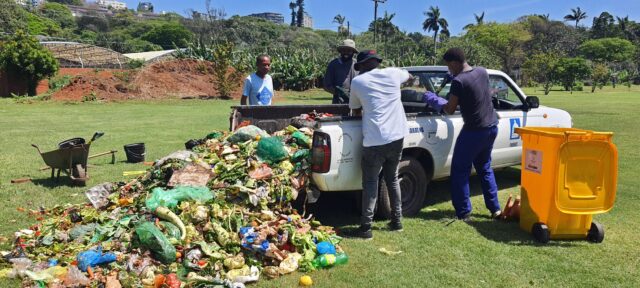
Lumec supported the Warwick Zero Waste (WZW) team in scaling up their pilot composting project. The WZW project started in early 2021 and is being implemented by Durban University of Technology’s (DUT) Urban Futures Centre (UFC), groundWork and Asiye eTafuleni. The aim of the project is to co-create a zero-waste to landfill case study, focussing on the Early Morning Market (EMM) in Durban’s Warwick Junction.
As part of the study, a survey was completed with 166 traders which identified information such as that 78% of the products sold were organics (fruit, vegetables, etc.), that 88% of traders are not sorting their waste, and that 92% of waste goes into the allocated wheelie bins. Thereafter, the WZW team undertook a waste categorisation assessment where bins were weighed over a period of 16 days, while a more granular sorting process was done on 10 of the bins each day.
Using this data, it was estimated that on average, 397 tonnes of waste was generated at the EMM per year, with 84.4% being organic fruit and vegetable waste. This waste is being collected by eThekwini’s Cleansing and Solid Waste unit and sent to landfill.
Given that the aim of the project is to identify zero waste to landfill solutions, the next step for the WZW team was to identify potential opportunities to divert this waste from landfill. Using a 2km radius, the Durban Botanic Gardens (which is only 1.5km from the EMM) was identified as a potential location which could be considered for a composting pilot project. After securing support from the Botanic Gardens team, the pilot process was started whereby 16 small compost heaps were created using 1 wheelie bin of food waste per week, combined with green and brown garden waste from the Botanic Gardens, to create 16 compost heaps over a period of 4 months. Throughout this pilot process, data was collected on the composition of each compost heap, and on a weekly basis, technical data was collected on the air temperature and humidity, soil moisture content and temperature, level of rainfall, etc.
Since the start of 2023, the WZW team has initiated a scale-up process, where a 1-ton bakkie was used to create a single large compost windrow. During March 2023, the WZW initiated a further scaling-up, whereby 12 windrows are being set up along with relevant drainage to capture leachate run-off. Given the success of the initial pilot project in creating a good quality compost product, the WZW team identified that significant potential exists to scale-up even further and divert a more substantial amount of food waste from the EMM into the production of compost. However, to do this it would require the support and buy-in from various municipal departments, and the viability of the proposed project would need to first be determined.
As such, the WZW team approached Lumec to undertake a cost-benefit analysis (CBA) which would identify both the economic and environmental costs and benefits of the pilot project and determine the viability should all food waste from the EMM be diverted into a full-scale composting operation. The CBA model identified that the savings from diverting waste from landfill (given the capital and operational costs associated with operating and maintaining landfills), coupled with the benefits from not needing to purchase compost and emissions avoided, far out weight the costs associated with producing this compost. The study resulted in a recommendation that the WZW compositing pilot should be scaled up, and that other similar decentralised composting solutions should be identified within the eThekwini Municipality.
You can access the full report here.